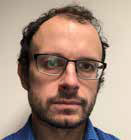
Abscope Environmental, Inc. is a Canastota, New York-based, full-service remediation firm in its 35th year of business, thanks to a proud legacy started by founders John Romagnoli and his son, Jack. Beginning in 1989 as solely an asbestos abatement company, Abscope expanded into more comprehensive environmental remediation services in 1994 and fast tracked its growth in 2004 when Jack’s brother Jerry came on board. Planning for their succession, Jack and Jerry looked to their youngest brother, Bob Romagnoli, to take the reins. Bob became President of Abscope in 2019 and later, CEO, in 2020 as both brothers retired. While the company has experienced tremendous growth since its founding, Bob and his partners are now poised to expand into new geographical regions, offer new and innovative services, and most importantly, sustain the business for the next generation.
An Experienced Leadership Team
With more than 25 years of environmental consulting experience, Bob Romagnoli is an engineer by trade, but brought a vast array of leadership and operational skills to help Abscope redefine itself as a more state-of-the-art organization. During his career, Romagnoli led multi-million-dollar Superfund sediment remediation programs and developed turn-key environmental strategies for Fortune 100 companies, serving as Sr. Vice President at Arcadis and Managing Director at TIG Environmental.
Working closely with Romagnoli are three key long-time Abscope employees: Executive Vice President Rob Gray, Executive Vice President Robert Duffy, and General Manager, Steve Mitchell. All three have been with the company for decades and are part owners of the firm.
Rob Gray joined Abscope in 1995 when he started as an estimator. Over time his role grew into a managerial one and he currently serves as the Executive Vice President of the Environmental Remediation and Geotechnical Services division. Gray has extensive experience in Manufactured Gas Plant (MGP) remediation, hazardous waste remediation, stream sediment removal, In-Situ Stabilization (ISS), sheet pile installation, deep excavations, and site development projects.
Executive Vice President Robert Duffy and General Manager Steve Mitchell lead the Asbestos Abatement and Industrial Decontamination division. They oversee the removal, encapsulation, enclosure, transportation, and disposal of asbestos-containing materials, building demolition, and lead and mold remediation. Duffy has been part of the Abscope team since its inception in 1989 and has been crucial to its success and growth. He is responsible for estimating, proposal development, submittal generation, waste disposal coordination, and final report development, not to mention business development.

Mitchell has been with the company 30 years and is responsible for coordinating manpower across both divisions, a task that can be very challenging, especially in today’s environment. “Stevie’s attention to detail is second to none” says Romagnoli. “He’s the ultimate team player and always puts the company’s interests first.”
Romagnoli said it took some time for the leadership team to learn how to best work together but have now struck the right balance. “These three guys have been here for decades and have significantly contributed to the success of this company,” said Romagnoli. “My role is to allow them to continue building on that success, while bringing a new perspective on operational and strategic matters.”
A Fresh Perspective
After joining Abscope, Romagnoli immediately identified several key areas for improvement, the most evident of which was in-house technology. While IT changes are never easy to implement, Romagnoli felt they were imperative to keeping Abscope at the forefront of the industry.
As an example, Abscope invested heavily in upgrading their take-off and estimating systems. The conversion to InSite and HeavyBid allowed for higher productivity and more accurate results. According to Romagnoli, the value was apparent from day one. “Our PMs have done a great job in assimilating to these new systems which in turn have allowed them to be much more productive. Given the complexity of the new platforms, we’ve only scratched the surface of their potential. I’m excited to see how much more we can extract and use to our benefit.”

Abscope also upgraded the GPS equipment on their “yellow iron” with the latest, most cutting-edge Trimble™ technology, including Trimble™ TSC7 v2s and R780 bases and rovers. The new equipment delivers the latest in field technology, optimizing efficiency and most importantly, accuracy. Abscope’s fleet is extensive, consisting of approximately 30 pieces of heavy equipment.
On the administration side, Abscope recently converted the invoice approval and payment process from paper-based to digital. “It is much more efficient for our PMs to digitally approve vendor invoices versus dealing with mounds and mounds of paper,” said Romagnoli. “The system has also minimized duplicate or erroneous payments.” Field Superintendents are also joining in Abscope’s IT revolution, now using tablet apps to track time, significantly reducing transcription errors within the accounting department.
New Horizons
From the types of projects, the size and scope of the work, and even the geographical location, much has changed at Abscope since its beginning in 1989. Most recently, there has been a surge of projects in the alternative energy space and Abscope has provided civil works for commercial-scale solar and wind projects. The work generally includes preparing the site for ultimate component installation by others and consists of earthwork, installation of storm water drainage, development of access roads, crane pads, and various other site features.
“Alternative energy has exploded for us, and it is not something that we necessarily expected,” said Romagnoli. “Smaller, more local opportunities have opened us up to much larger and broader opportunities nation-wide.” In fact, there has been so much growth, Abscope is considering the creation of a new division to execute the work.
Abscope’s job size and scope
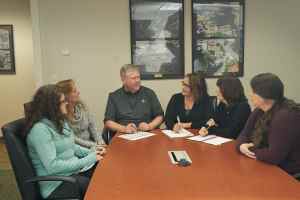
has changed too over the years. In the early years, jobs were $500,000 or less lasting up to a month, but now jobs range from $10 to $12 million lasting six months to a year. “The diversity of our projects shows how we have grown,” said Gray. “Today our projects are more complicated and the systems we have been installing are much more sophisticated.”
Geographically things are changing as well. Gray recalls in the early days, most of the work was within a two-to-three-hour radius, but not lately. Remediation projects are bringing Abscope’s crews to the Mid Atlantic, Midwest, Southeast, Southwest, and as far away as Puerto Rico. In 2022, they successfully completed a challenging six-month project in Dallas, TX with a world-renowned chemical manufacturer, where Abscope remediated asbestos contaminated soil on residential and small commercial properties. “We are now set up well to handle these larger, more complex projects,” said Romagnoli. “It is exciting to see such large and iconic companies/clients view us as a trusted partner.”
Thanks to the successful completion of the Dallas project, the very same Fortune 500 client selected Abscope for a large PCB soil remediation project in Puerto Rico in 2024. “We are grateful to them for giving us this unique opportunity to assist in such a highly visible and intricate project, especially in a geographic location that’s not necessarily familiar to us.” Abscope has invested a significant amount of time and money to make sure the project goes off without a hitch. “Ideally we’d love to leverage this opportunity to do other work (e.g., emergency response and disaster assistance) in Puerto Rico in future years, but for now, we need to keep our eye on the ball and ensure that this critical project is successful” said Romagnoli.
With Romagnoli’s experience

in sediment removal, stream remediation, and shoreline stabilization, Abscope has been doing more work in those markets as well. “We most recently did a shoreline stabilization job in Lackawanna along Lake Erie,” said Gray. “With all the erosion from wind and waves, shoreline stabilization has been a big area of focus for us.” The addition of wetland and stream remediation is one example of how complex their current projects are due to the adherence to regulations with the Environmental Protection Agency (EPA) and the Department of Environmental Conservation (DEC) on the plantings, soils, and rocks required during the restoration process.
As work around the country continues to grow, Romagnoli and Gray are considering an expansion into new office locations. “We are looking to expand in the near future and discussing our growth plans for the Mid Atlantic area,” Gray said. With upcoming work in Puerto Rico, Romagnoli could see an office location in Florida as well to support the Southeast and Caribbean. “There is a lot of potential there, just a question of if and where,” he said.
Safety First
From environmental remediation to asbestos abatement, sediment dredging to shore stabilization, deep excavation to restoration, safety is Abscope’s number one priority. Duffy was instrumental in the creation of project-specific health and safety work plans for Abscope’s company-wide, behavior-based Health and Safety program. His daily interaction with clients, regulatory personnel, subcontractors, and project engineers as well as having managed or supervised over 3,500 asbestos abatement projects gives him a keen understanding of the safety issues facing field workers. “There are so many things that could go wrong on a job,” said Duffy. “We have to get ahead of it and make sure everyone is as safe as possible.”
On project sites, Abscope superintendents hold Toolbox Talks or safety meetings every morning to discuss the particulars of the job, what protective equipment is required, and what to do if something goes wrong. “Our guys in the field are very diligent when it comes to safety; they know there are no short cuts,” said Romagnoli.
The leadership team, Project Managers, and employees in the field also attend monthly safety calls to share stories about “good catches;” things on the job that could cause an injury. Good catches are recognized on the monthly safety calls and quarterly safety awards are given out to employees who are most focused on safety. “We rank health and safety here above everything else,” said Gray. “We take it very seriously.”
Investing in the Future
One of Romagnoli’s other priorities has been to bolster Abscope’s employee benefits and incentives. Romagnoli is focused not only on employee retention but attracting new talent as well. As an example, Romagnoli established a 401(k) program for the company back in 2020 to help employees help themselves. Abscope also provides a generous match. In addition, Romagnoli also set up a tuition reimbursement program that is meant to

encourage staff to continuously improve their skills. “We’re always looking to get better, but we want to make sure to take care of those that continue to make this company what it is,” he said.
Looking ahead to the future, Romagnoli would like to see the company grow to $25-30 million over the next five years. From acquisitions to new office locations, he is focused on building out systems and services to benefit the next generation. “My Dad would be bursting with pride seeing that the company has stayed in the family and become so much more than what he anticipated it to be,” he said. There is the potential for other family members to join the company at some point, but for now, Abscope is flourishing under current ownership. By honoring the past and continuing the proud legacy of the Romagnoli family into the future, Abscope is poised to be sustainable for generations to come.


 We are planning a Heritage trip and have spent hours doing research. My daughter pulled up Chat GPT, gave it a few directions and in 30 seconds it listed an itinerary, things to visit, and lots of other info for consideration.
 Is fear of contracting the COVID-19 virus a compensable mental injury under the Workers’ Compensation statute? On July 20, 2023, The Appellate Division-Third Department in three separate unanimous opinions decided the issue with a resounding “NO”.
 The New York construction industry, and realistically the entire New York business landscape, is in the midst of an insurance hard market. The lack of insurance availability and the pricing volatility associated with it is leaving consumers in a difficult place when it comes to their insurance renewals. Although insurance options may be limited, it’s critical to know what or who those options are and when to approach them. Proactively managing your program can be an effective solution to unpredictable insurance renewals.
 When purchasing new construction equipment, one of the most important factors to consider is the financing option that works best for your needs. Paying in cash may be the most convenient and cost-effective option as it eliminates the concerns of long-term debt, high interest rates and debt-to-equity ratios. However, most construction companies opt for financing due to the lack of available funds.
 By most measures, 2023 was a strong year for construction industry employers throughout upstate New York. Measuring growth can be subjective, however, the increase in membership at the Syracuse Builders Exchange is one standard metric which is objective. Membership increased to 970 at the end of 2023, with 42 new member employers joining during the year. Today, the Syracuse Builders Exchange remains the largest construction industry Association in the state of New York.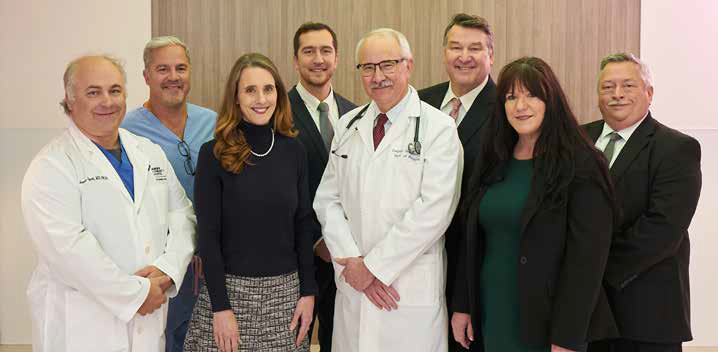
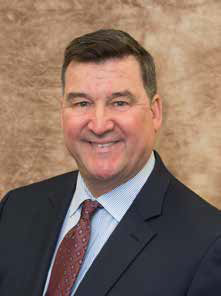
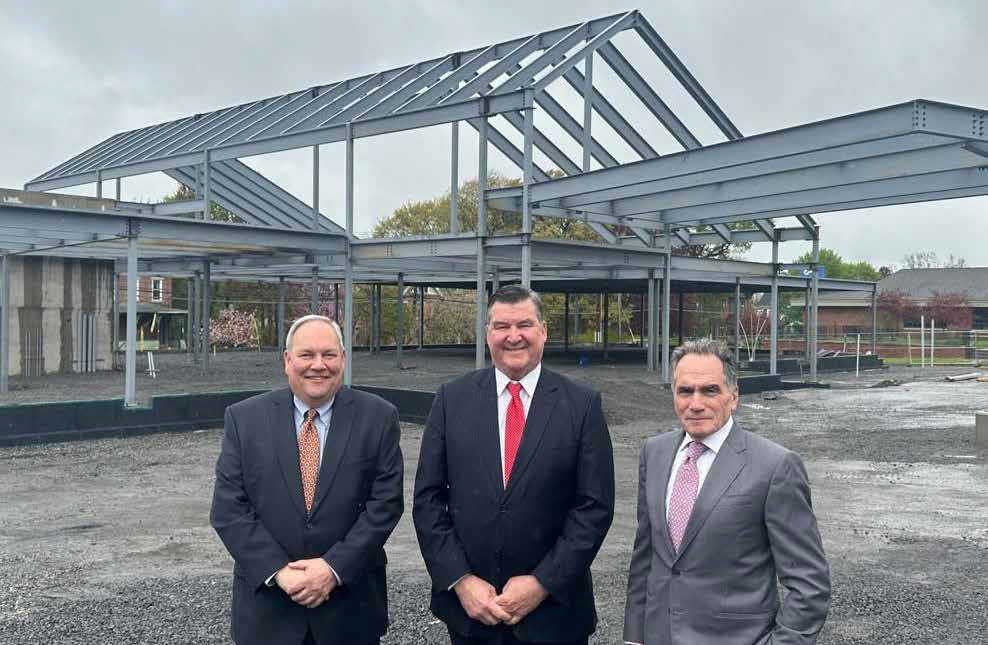
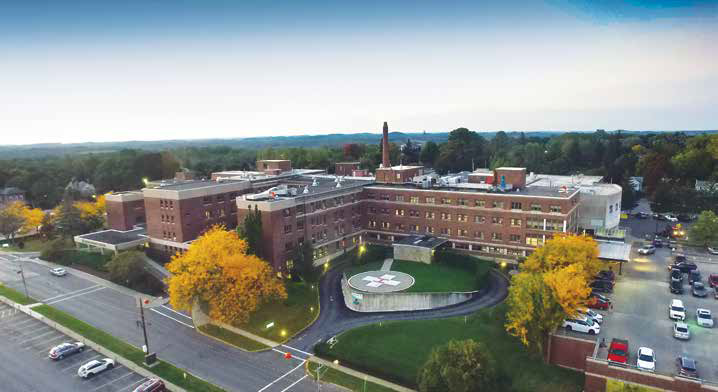
 Demand for ACH’s services, utilization and growth continues to increase as we bring acute, post-acute and preventive care to members of our community. What I am most proud of is according to a recent study by The University of Wisconsin Population Health Institute, Cayuga County has experienced remarkable year over year improvements in health outcomes vs. other NYS counties over the last 10 years despite numerous challenging health factors. That means as the only health system in the area we are making a difference in our community when it comes to health outcomes,” he said.
 shopping” for their medical treatments, since the Cancer Center is connected to the main hospital. Combined with the partnership of excellent SUNY Upstate cancer physicians, this increased convenience for patients will provide for more efficient, cost effective, and quality care right in their own community. Dr. Komal Akhtar, Medical Director for the new Cancer Center, has extensive training in Internal Medicine, Hematology and Medical Oncology, and is a member of the American Society of Clinical Oncology. She expressed her excitement about the impact the new Cancer Center will have on the area served by ACH.
 Alongside the addition of the Cancer Center, ACH is enhancing the level of cardiovascular care for its patients with the new Auburn Heart Institute. Located in a newly renovated wing on the third floor of ACH, this multimillion-dollar investment in cardiac care will be led by Dr. Ronald Kirshner, who was recently appointed as its chair and medical director. Dr. Kirshner recently served as the Chief of Cardiac Services and Cardiothoracic Surgery at Rochester Regional Health Sands Constellation Heart Institute for over 30 years, and his clinical interests and expertise include creating systems to drive healthcare efficiency and quality.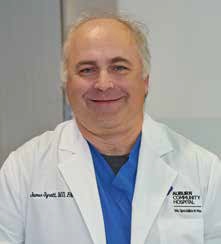
 Another important addition to the team at ACH is Dr. James Syrett, who joined the hospital in May of 2023 as the Chief Medical Officer. Board certified in both Emergency Medicine and EMS Medicine, Dr. Syrett has become only the third physician within a 100 mile radius of Auburn to be certified by ImPACT Applications Inc., a leading provider of concussion management tools, which helps ensure healthcare providers have the necessary skills and knowledge to use the tools effectively. Utilizing his extensive experience in EMS and Emergency Medicine, as well as an interest in the emergency management of concussions. Dr Syrett will serve as the Medical Director of the new Auburn Concussion Clinic, which opened in October and is seeing patients next day when referred from other physicians. This gives patients immediate access to concussion specialists, which is unusual in this region.
 We are planning a Heritage trip and have spent hours doing research. My daughter pulled up Chat GPT, gave it a few directions and in 30 seconds it listed an itinerary, things to visit, and lots of other info for consideration.